Frequently Asked Questions
The most-asked questions about metrology.
What exactly is metrology?
Metrology is the science of measurement, covering how standards are defined, how instruments realize them, and how uncertainty is quantified so that results are meaningful and comparable. It is broader than simply reading a gauge; it includes the theoretical framework, traceability chains, and legal frameworks that make measurement trustworthy.
Who are the most important historical figures in the field?
The French scientists who established the meter and kilogram in the 1790s laid the foundation for the metric system, while later figures such as the contributors to the 2019 SI redefinition (including teams at NIST, PTB, and NPL) moved every base unit onto fundamental constants. No single individual dominates the field—it has always been a collaborative, international effort.
Where should a newcomer start learning metrology?
Begin with the seven SI base units and the concept of traceability, then work through measurement uncertainty (the GUM framework) before moving into specialized areas like electrical, thermal, or optical metrology. A short course on dimensional analysis and error propagation will give you the language to read the rest of the literature.
What are the seven SI base units?
They are the metre, kilogram, second, ampere, kelvin, mole, and candela. Since the 2019 revision, each is defined by fixing the numerical value of a fundamental constant (such as the speed of light or Planck's constant) rather than by a physical artefact.
What is the difference between accuracy and precision?
Accuracy describes how close a measurement is to the true value, while precision describes how tightly repeated measurements cluster together. A set of readings can be precise but inaccurate (consistently biased) or accurate on average but imprecise (highly scattered).
What is the BIPM and why does it matter?
The International Bureau of Weights and Measures, housed in Sèvres near Paris, coordinates the global SI system and maintains the reference standards that national metrology institutes compare against. It organizes the CGPM, the governing body that approves changes to the unit definitions.
What was the 2019 SI redefinition and why is it a landmark moment?
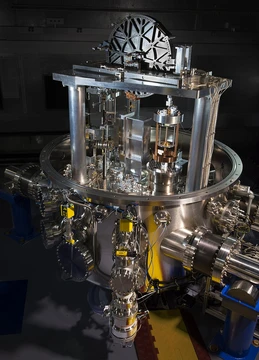
On 20 May 2019, all seven SI base units were re-expressed in terms of fixed values of fundamental physical constants, replacing the last artefact-based definition (the platinum-iridium kilogram cylinder). This means the units are now, in principle, reproducible anywhere in the universe without needing a physical object.
What does 'traceability' mean in metrology?
Traceability is the unbroken chain of comparisons linking a measurement result back to a defined reference, usually an SI unit, with each step carrying a stated uncertainty. It is what allows a factory in one country and a lab in another to agree that 'one metre' means the same thing.
How does metrology show up in everyday life?
Every time a fuel pump dispenses litres, a pharmacy dispenses a milligram dose, or a smartphone's GPS fixes your position, metrology underpins the result. It also drives cutting-edge work such as quantum sensors, semiconductor lithography, and tests of fundamental physics.
How is metrology different from simply 'taking a measurement'?
Taking a measurement is an act; metrology is the discipline that tells you what that number means, how much you can trust it, and how it connects to the international system. Without metrology, a reading on a scale is just a number with no guaranteed relationship to the kilogram or to another lab's reading.