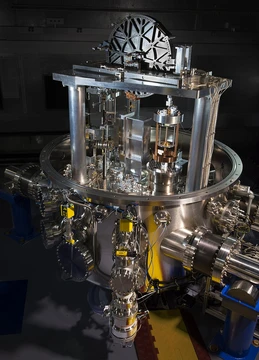
Avoirdupois

Avoirdupois (abbreviated avdp.) is a measurement system of weights that uses pounds and ounces as units. It remains the everyday system of weights used in the United States, and is still used, in varying degrees, in everyday life in the United Kingdom, Canada and some other former British colonies, despite their official adoption of the metric system.
- field
- Measurement system of weights
- known_for
- Standard pound and ounce system used in daily life in the US, UK, Canada, and other former British colonies
- first_commonly_used
- 13th century CE
Lore & Background
The avoirdupois weight system's general attributes were originally developed for the international wool trade in the Late Middle Ages, when trade was in recovery. It was historically based on a physical standardized pound or 'prototype weight' that could be divided into 16 ounces. There were a number of competing measures of mass, and the fact that the avoirdupois pound had three even numbers as divisors (half and half and half again) may have been a cause of much of its popularity, so that the system won out over systems with 12 or 10 or 15 subdivisions. The use of this unofficial system gradually stabilized and evolved, with only slight changes in the reference standard or in the prototype's actual mass. Over time, the desire not to use too many different systems of measurement allowed the establishment of 'value relationships', with other commodities metered and sold by weight measurements such as bulk goods (grains, ores, flax) and smelted metals, so the avoirdupois system gradually became an accepted standard through much of Europe. Late in the 19th century various governments acted to redefine their base standards on a scientific basis and establish ratios between local avoirdupois measurements and international SI metric system standards. The legal actions of these various governments were independently conceived, and so did not always pick the same ratios to metric units for each avoirdupois unit. The result of this was, after these standardisations, measurements of the same name often had marginally different recognised values in different regions (although the pound generally remained very similar).
Reader's Guide
The avoirdupois system is significant as the everyday weight system in the United States and still used in varying degrees in the United Kingdom, Canada, and some other former British colonies. Its origins lie in the Late Middle Ages, tied to the international wool trade, and it gradually became an accepted standard through much of Europe. The system's popularity may have been due to its pound having three even divisors (half and half and half again), allowing easy subdivision into 16 ounces. The word 'avoirdupois' originally referred to a class of merchandise—'goods of weight'—sold in bulk and weighed on large balances, and only later became identified with the system of units. An alternative system, the troy system, also denominated in pounds and ounces, is generally used for precious materials.
Did You Know?
- The word 'avoirdupois' is from Anglo-Norman French 'aveir de peis', literally 'goods of weight'.
- The avoirdupois pound was not historically synonymous with
Etymology and Roman Roots
The very word 'pound' entered the Germanic languages as a borrowing of the Latin phrase libra pondo, meaning the weight measured in libra, with pondo being the ablative singular form of pondus, the Latin noun for weight. This Proto-Germanic adoption left a family of cognates across Northern Europe: German Pfund, Dutch pond, and Swedish pund all carry the same ancestral meaning. Scribes in medieval Europe further compressed the term into the abbreviation lb, and a more ornate variant, the symbol ℔, persisted specifically for the apothecaries' pound. Even today, when confusion with pound-force is a concern, alternative notations such as lbm or the hash mark # appear in American contexts. The Roman libra thus lives on not merely as a historical curiosity but as the structural backbone of one of the most widely recognized mass units in the English-speaking world.
The Modern International Standard
This was no arbitrary figure. The conversion factor was deliberately selected so that it would be divisible by seven and yield a terminating decimal, ensuring that the pound's subdivision into 7,000 grains would translate cleanly into the metric system. The pound itself is divided into sixteen avoirdupois ounces, a structure that has remained stable for centuries. The standard symbol lb remains the internationally recognized notation, though contexts where the pound might be mistaken for a unit of force call for the disambiguating suffix lbm. What began as a medieval wool merchant's measure had, by the mid-twentieth century, become a precisely anchored international standard.
Historical Evolution in Britain
Britain's history with the pound is layered with competing standards. Under Elizabeth I, it was redefined to exactly 7,000 troy grains, a value that anchored the grain as a permanent fixture of the system. Alongside the avoirdupois system persisted the troy pound, still used today for weighing precious metals like gold and silver, where tradespeople quote weights simply in ounces and assume the troy standard unless otherwise stated. The monetary history is equally tangled: the pound sterling, introduced under King Offa of Mercia, was originally grounded in a Saxon pound of silver.
The Ongoing Coexistence with Metric
Despite the global spread of the metric system, the pound has proven remarkably stubborn in the territories where it took root. The result is that the United States stands as the sole industrialized nation where commercial activity does not predominantly operate in metric terms, and the pound remains one of the most visible units in everyday trade. In the United Kingdom, the trajectory was similar: European directives and domestic metrication efforts were expected to phase out the pound and ounce entirely. The persistence of the unqualified word 'pound' in common speech also reflects a deeper historical conflation of mass and weight, a distinction that modern terminology now separates into pound-mass and pound-force. Across both nations, the avoirdupois pound endures not as a relic but as a living standard woven into law, commerce, and daily language.
Frequently Asked Questions
What is Avoirdupois?
Avoirdupois (abbreviated avdp.) is a traditional system of weights built around the pound and the ounce. It is the system most people in the United States encounter when shopping or measuring goods.
When was Avoirdupois first commonly used?
The system traces its widespread everyday use back to the 13th century CE, making it nearly eight centuries old at this point.
Where is Avoirdupois still in everyday use?
It remains the standard daily weight system in the United States, and it continues to appear in everyday life across the United Kingdom, Canada, and several other former British colonies even though those countries have officially adopted metric.
Why does Avoirdupois matter in metrology?
Because it is still the go-to system for weighing in multiple English-speaking countries, it represents one of the last major pre-metric measurement frameworks with genuine, ongoing practical relevance.
More in Metrology 25-27
Elsewhere in the Metrology universe
Spotted an error? Know more?
This is a living reference — every entry is fact-audited, and reader corrections feed straight into our audit queue. Suggest an edit · See this site's audit record