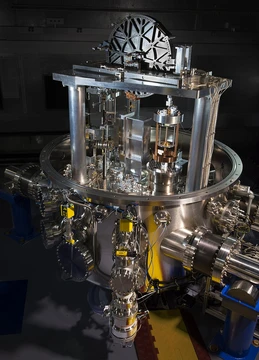
International Prototype of the Kilogram

It was used to calibrate all other kilogram mass standards on Earth and was the only base unit directly defined by the IPK.
- location
- BIPM vault, Pavillon de Breteuil, Sèvres, France
Lore & Background
The Metre Convention was signed on 20 May 1875, leading to the production of the IPK. The IPK is stored with six sister copies in a controlled basement vault at the BIPM in Sèvres, requiring three independently controlled keys to open. Official copies were made available to other nations as national standards, compared to the IPK roughly every 40 years.
Reader's Guide
It underpinned the definitions of the kilogram, mole, ampere, and candela, and indirectly all named SI derived units except the hertz, becquerel, degree Celsius, gray, sievert, farad, ohm, siemens, henry, radian, and steradian. The IPK may have lost about 50 μg relative to its copies, with no plausible mechanism identified. This drift, along with the impracticality of a physical artifact, motivated the 2019 redefinition based on physical constants. The IPK's legacy includes the meticulous cleaning and handling protocols developed to minimize contamination and wear, and the international cooperation embodied in the network of national prototypes.
Did You Know?
- The IPK is made of a platinum-iridium alloy called Pt‑10Ir, which is 90% platinum and 10% iridium by mass.
- The IPK and its six sister copies are stored in a basement vault at the BIPM in Sèvres, France, requiring three keys to open.
Material and Form: Engineering a Perfect Standard
The International Prototype of the Kilogram takes the shape of a small right-circular cylinder, roughly the size of a golf ball, with a diameter and height of approximately 39 millimetres. This geometric choice was deliberate: by keeping the height equal to the diameter, the object's surface area is minimised, which in turn limits the amount of material exposed to contamination or wear. The cylinder is forged from a specific platinum–iridium alloy designated Pt‑10Ir, containing ninety percent platinum and ten percent iridium by mass. The iridium was added to solve a practical problem with the earlier all-platinum Kilogramme des Archives: it dramatically increased the hardness of the metal while preserving platinum's most valuable properties. Those properties include exceptional resistance to oxidation, a very high density—nearly double that of lead and more than twenty-one times that of water—satisfactory electrical and thermal conductivity, and low magnetic susceptibility. Together, these characteristics made the alloy an ideal candidate for an object that would serve as humanity's definitive reference for mass for over a century.
From Convention to Ratification
The path from international agreement to a physical artefact was neither instant nor simple. The Metre Convention, signed on 20 May 1875, formalised the metric system and set in motion the production of a new universal mass standard. From that moment, the object—known to metrologists as the IPK, or Le Grand K, and sometimes as the ur-kilogram in German-language literature—became the single physical anchor for the world's system of mass measurement.
A Global Web of Standards
The IPK did not sit alone. In a basement vault at the BIPM's Pavillon de Breteuil in Saint-Cloud, on the outskirts of Paris, it is kept alongside six sister copies designated K1, 7, 8, 32, 43, and 47 in a tightly controlled environment, with three independently controlled keys required to open the vault. Ten additional working copies—eight for routine calibration and two reserved for special use—reside in the BIPM's nearby calibration laboratory. Far more significant for the wider world is the network of national prototypes distributed to dozens of countries, from Argentina to the United States, with some nations holding multiple copies. These national standards were compared to the IPK roughly every forty years in a process called periodic verification, ensuring that every local measurement could be traced back to the single Paris cylinder.
Drift, Decline, and the End of a Physical Standard
By definition, the IPK's mass was exactly one kilogram, so any error in its measured value was, by fiat, zero. Yet the copies scattered around the world told a different story. More troubling was K4, a check standard used far more frequently and therefore more susceptible to scratches and wear. Even carefully stored national prototypes exhibited drift for both known and unknown reasons, since all the objects sat in air beneath nested bell jars. By 2018, the IPK underpinned four of the seven SI base units and nearly every named derived unit. In 2019, the kilogram was finally redefined in terms of physical constants, ending the era of a physical artefact.
More in Metrology 1-24
Elsewhere in the Metrology universe
Spotted an error? Know more?
This is a living reference — every entry is fact-audited, and reader corrections feed straight into our audit queue. Suggest an edit · See this site's audit record